
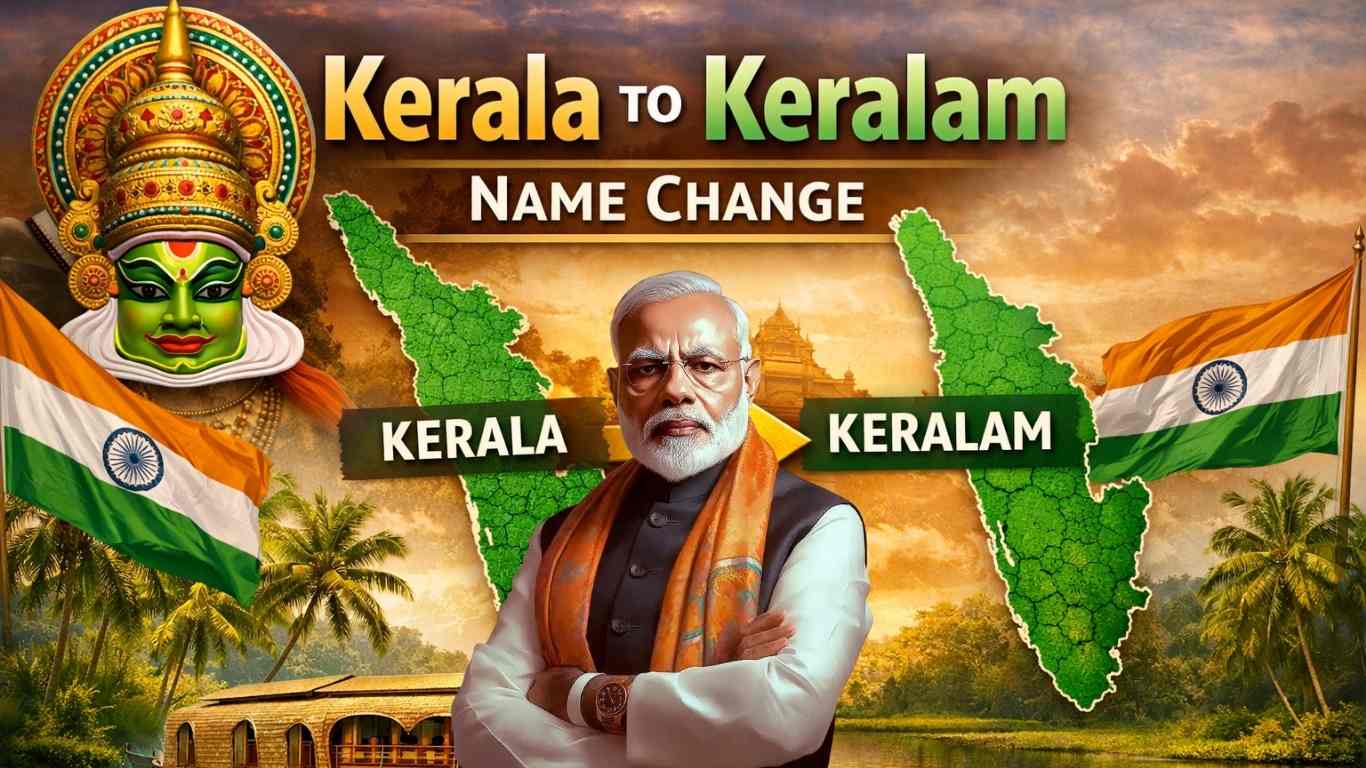
Published: March 11, 2026 | Reading Time: 8 minutes | Author: Rozers
A 68-Year Wait Ends
“I can see the joy on all your faces.”
That’s what Prime Minister Narendra Modi told a packed audience in Kochi on March 11, 2026. But he wasn’t talking about a new highway or a welfare scheme. He was celebrating something far more personal for millions of Malayalis—their homeland finally getting its “rightful name.” as Kerala to Keralam name change.
Kerala to Keralam Name Change: A 68-Year Wait Ends
The Union Cabinet approved the name change on February 24, 2026, marking the end of a decades-long demand that began even before the state was formally created in 1956. For many, this isn’t just bureaucratic paperwork. It’s about reclaiming identity from colonial shadows.
But why now? And what does changing a single letter—from ‘a’ to ‘m’—actually signify for India’s federal structure?
Let’s dig deeper.
Historical Context Behind the Kerala to Keralam Name Change
Here’s something most Indians don’t know: the state was never actually called ‘Kerala’ in Malayalam.
When the British mapped the region in the 18th and 19th centuries, they struggled with Indian phonetics. Words ending in ‘m’ or hard consonants got anglicized for easier pronunciation. ‘Keralam’ became ‘Kerala’ in official records. The Kerala to Keralam name change stuck through independence, through the States Reorganization Act of 1956, and through 68 years of statehood.
“The British could not pronounce spellings with names ending with ‘m’,” explains Professor Shaji A. from the University of Kerala. “So they changed it as per their convenience. But in Malayalam, it has always been Keralam.”
Kerala to Keralam name change | The Etymology: Land of Coconuts
The word itself carries deep geographic meaning:
- ‘Kera’ = Coconut tree (the state’s most iconic symbol)
- ‘Alam’ = Land or region
Keralam = The Land of Coconuts
It’s not just poetic. Kerala produces roughly 45% of India’s coconut output. The name describes the landscape itself—row upon row of coconut palms defining the horizon.
The Political Journey: From Assembly Resolution to Cabinet Approval
June 24, 2024: The Unanimous Demand
The Kerala Legislative Assembly did something rare in Indian politics—it achieved consensus.
Chief Minister Pinarayi Vijayan moved the resolution. The Opposition Congress-led UDF supported it. Even the BJP, which holds no seats in the Assembly, publicly backed the move. Every single MLA agreed: the time had come to correct a historical anomaly.
The resolution stated:
“The name of our State is ‘Keralam’ in Malayalam Language. States were formed on the basis of language on the 1st day of November, 1956… But in the First Schedule to the Constitution the name of our State is recorded as ‘Kerala’.”
But there was a hitch.
The Technical Rejection (2023)
In case of Kerala to Keralam name change This wasn’t the first attempt. In August 2023, the Assembly passed a similar resolution. The Centre sent it back.
Why? The Eighth Schedule mistake.
The 2023 resolution asked for the name change across all 22 languages listed in the Constitution’s Eighth Schedule. Problem: the Eighth Schedule lists languages, not state names. The Home Ministry flagged the error, forcing the state to redraft.
The 2024 version corrected this, focusing solely on the First Schedule (which actually lists state names). This time, it cleared the bureaucratic hurdles.
February 24, 2026: Cabinet Approval
The Union Cabinet, meeting at the newly inaugurated Seva Teerth complex (the new PMO building), gave its green light. The process now moves to:
- Presidential Reference: The Kerala (Alteration of Name) Bill, 2026 goes to the state Assembly for views
- Parliamentary Approval: Simple majority needed in both Houses
- Presidential Assent: Final signature making it law
Given the unanimous state support, parliamentary passage seems procedural rather than political.
PM Modi’s Kochi Speech: Politics and Timing
March 11, 2026. Kochi, Kerala.
Prime Minister Modi wasn’t there just to celebrate a Kerala to Keralam name change. He was launching the NDA’s campaign for the upcoming Kerala Assembly elections. The timing? Impeccable.
Addressing the Golden Jubilee celebration of Akhila Kerala Dheevara Sabha (a fishermen’s rights organization), Modi framed the Kerala to Keralam name change as fulfillment of a promise:
“The long wait of my Malayali brothers and sisters has come to an end. You have all been demanding for years that Kerala’s name be changed to Keralam. Our BJP-led NDA government at the centre has approved this proposal.”
He coupled this with announcements of ₹10,800 crore in development projects, including:
- Polypropylene Unit at Kochi Refinery (₹5,500 crore)
- Six-laning of Thalapady-Chengala highway section (₹2,650 crore)
- Kozhikode Bypass expansion (₹2,140 crore)
The Fishermen Connection
Modi’s choice of venue wasn’t accidental. The Dheevara Sabha represents Kerala’s fishing community—a significant vote bank. He announced ₹1,400 crore under the Pradhan Mantri Matsya Sampada Yojana specifically for the sector.
“The world considers water, rivers, and seas a resource,” Modi said. “Dheevara community considers oceans as its ‘amma’ (mother).”
The message: the Centre respects both Malayali culture and its working-class communities.
The Bigger Picture: India’s Name Changing Trend
Kerala to Keralam name change isn’t alone in this journey. It’s part of a broader post-colonial reclamation happening across India:Table
| Old Name | New Name | Year |
|---|---|---|
| Madras | Tamil Nadu | 1969 |
| Mysore | Karnataka | 1973 |
| Bombay | Mumbai | 1995 |
| Madras (city) | Chennai | 1996 |
| Calcutta | Kolkata | 2001 |
| Bangalore | Bengaluru | 2006 |
| Orissa | Odisha | 2011 |
| Uttaranchal | Uttarakhand | 2007 |
| Allahabad | Prayagraj | 2018 |
Each change follows similar logic: endonym over exonym (native name over foreign name).
Dr. K.N. Ganesh of the Kerala Council of Historical Research puts it simply: “We are shifting the word from British colonial connotation to Malayalam linguistic connotation.”
The Practical Challenges for Kerala to Keralam name change : What Changes Now?
The Cost Factor
Name changes aren’t free. Estimates for Kerala/Keralam range between ₹400 crore to ₹1,000 crore based on previous state renamings. Expenses include:
- Government stationery and letterheads
- Official signage and public boards
- Website domain changes
- Legal document updates
- Tourism material rebranding
However, Kerala’s tourism-heavy economy might actually benefit. A unique, culturally-rooted name could strengthen brand identity in international markets.
The Linguistic Dilemma
Congress MP Shashi Tharoor raised a practical concern on X (formerly Twitter):
“What happens now to the terms ‘Keralite’ and ‘Keralan’? ‘Keralamite’ sounds like a microbe and ‘Keralamian’ like a rare earth mineral…”
In Kerala to Keralam name change discussions he’s not wrong. Language adapts slowly. ‘Malayali’—referring to the people and language—will likely remain dominant. But ‘Keralam’ as the place name creates consistency between spoken Malayalam and official English.
International Recognition
For the million-plus Malayali diaspora in the Gulf (particularly UAE), this change resonates deeply. Many have always called it ‘Keralam’ in conversation while writing ‘Kerala’ on official forms.
“It’s like the world catching up to how we’ve always spoken,” says Mini Thomas, a teacher from Kollam now based in Dubai.
Why This Matters Beyond Kerala
Federalism and Identity
Article 3 of the Constitution allows Parliament to alter state names, but the process requires state consultation. Kerala’s case shows this federal balance working—state initiative, Centre approval, constitutional amendment.
Linguistic States Principle
When India reorganized states on linguistic lines in 1956, the idea was simple: language defines identity. Kerala’s name change completes that vision. The state formed for Malayalam speakers now bears its true Malayalam name.
Precedent for Others?
Will West Bengal follow? The state Assembly passed a resolution to change the name to ‘Bangla’ in 2017, but the Centre hasn’t moved on it. Chief Minister Mamata Banerjee has publicly questioned the delay, especially after Kerala’s swift approval.
The difference: Kerala’s proposal had no political opposition in the state. Bengal’s politics are more complex.
FAQ: Kerala to Keralam name change
Q: Is the name change immediate? A: No. The bill needs Presidential reference, Assembly views, and Parliamentary passage. Expect 3-6 months minimum.
Q: Will old documents become invalid? A: No. Usually, both names remain valid for 1-2 years during transition.
Q: What about ‘Kerala’ in company names? A: Private entities can choose to rebrand or retain old names. Kerala Tourism might become ‘Keralam Tourism.’
Q: Does this affect the Malayalam language name? A: No change needed—it was always ‘Keralam’ in Malayalam.
Q: Why did the 2023 resolution fail? A: It incorrectly referenced the Eighth Schedule (languages) instead of the First Schedule (state names).
Conclusion: A Name, Finally Home
For 68 years, Kerala lived with a name imposed by those who couldn’t pronounce its original. That changes now.
Whether you see this as necessary correction or political symbolism, the message is clear: India is increasingly comfortable with its pre-colonial identities.
As PM Modi told the crowd in Kochi: “This beautiful state got its rightful name as per Malayali culture.”
The coconut palms haven’t changed. The backwaters remain the same. But for millions of Malayalis, something fundamental just clicked into place.
Welcome to Keralam.
Sources & References
- The Hindu, “Kerala to ‘Keralam’: Union Cabinet approves changing name of state,” February 24, 2026
- The Print, “Kerala to ‘Keralam’: What the name change signifies,” February 24, 2026
- India Today, “Kerala Assembly passes resolution to rename state to ‘Keralam,'” June 24, 2024
- DD News, “PM Modi hails renaming of Kerala as ‘Keralam,'” March 11, 2026
- New Indian Express, “KERALA-M: What’s in a name?” March 7, 2026
Last Updated: March 11, 2026
[…] Naree Attack: Thai Bulk Carrier Hit in Strait of Hormuz 7 Powerful Facts About the Kerala to Keralam Name Change After 68 Years Inside the Studio: A Day in the Life of a Contemporary Artist Minimal Living: Creating Space for […]