
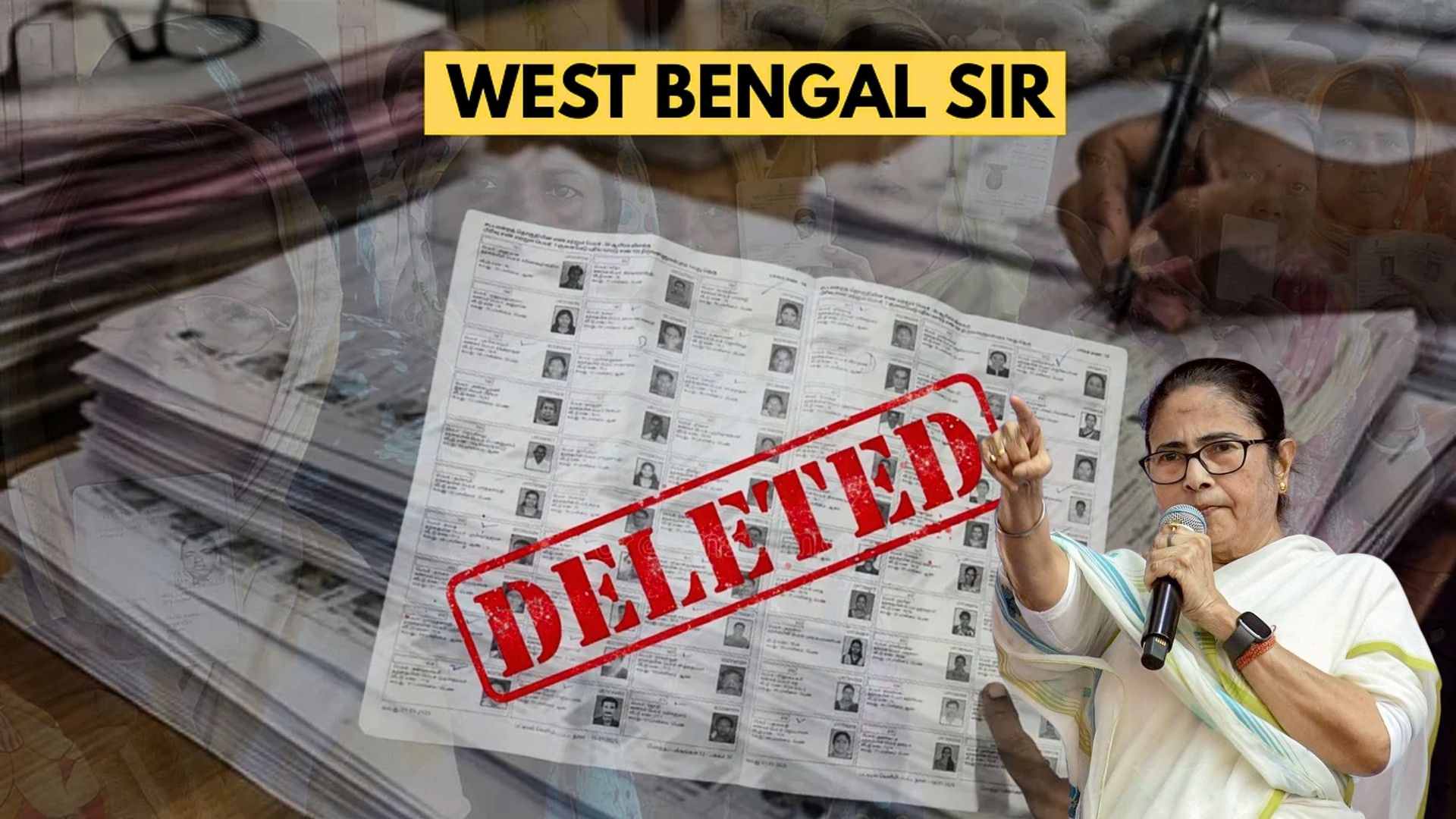
West Bengal voter deletion 2026 has triggered a massive political storm after over 91 lakh names were removed from the electoral rolls ahead of the state elections. Nadia Mondal has lived in North 24 Parganas for 27 years. She is married, has a home, and carries an Aadhaar card. She submitted every document the authorities asked for. This West Bengal voter deletion 2026 issue has raised serious questions across the country. The West Bengal voter deletion 2026 process is now under intense political scrutiny.
Her name was still deleted from the voter list.
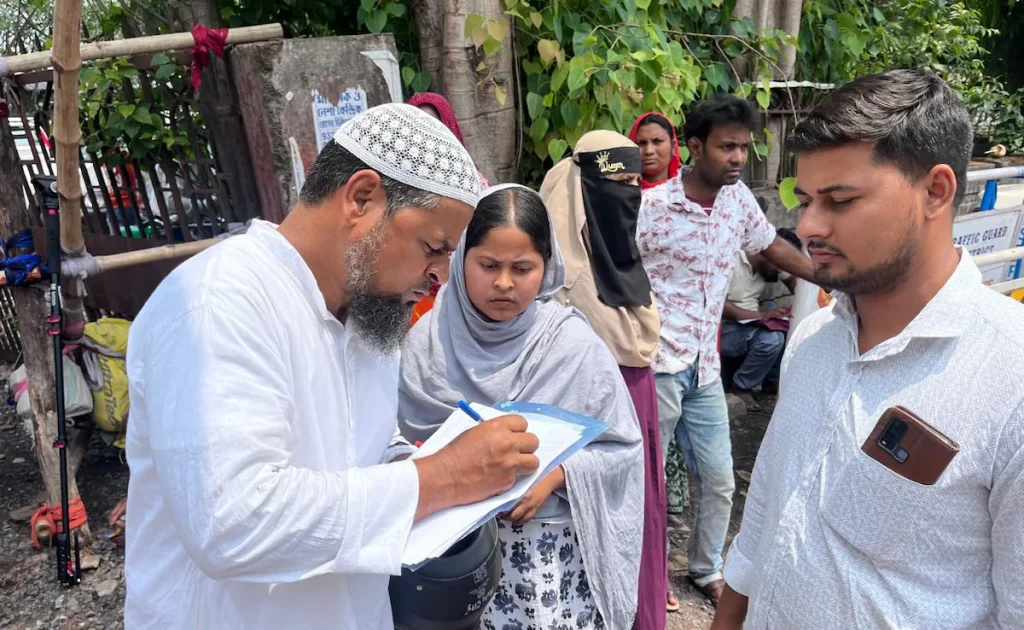
West Bengal’s voter deletion controversy of 2026 has turned into the most explosive political dispute the state has seen in years. Over 91 lakh names — nearly 12% of the entire electorate — have been struck from the electoral rolls through a process called Special Intensive Revision, or SIR. With two phases of polling scheduled for April 23 and April 29, and results due May 4, the timing could not be more charged. This situation raises critical questions about the west bengal voter deletion 2026 and its implications.
At the heart of this storm sits a question no one can answer cleanly: who exactly was deleted — and why? This West Bengal voter deletion 2026 issue has become one of the biggest election controversies in India.
West Bengal Voter Deletion 2026: What Is SIR?
The ongoing debates regarding the west bengal voter deletion 2026 highlight the complexities of electoral integrity and public trust. The West Bengal voter deletion 2026 process was carried out under the Special Intensive Revision. The West Bengal voter deletion 2026 process is now under intense political scrutiny.
The Election Commission of India ordered a Special Intensive Revision of West Bengal’s voter rolls ahead of the 2026 state assembly elections. The stated aim was simple — clean up the list by removing dead voters, duplicates, and those who had permanently moved away.
The revision process began with around 63.66 lakh names removed from the final SIR list published on February 28, representing about 8.3% of the electorate. A further 60.06 lakh cases were placed under adjudication — judicial review — of which 27.16 lakh additional names were found ineligible. Asharq Al-Awsat
The combined total now stands at approximately 90.83 lakh — reducing the voter base from 7.66 crore to just over 7.04 crore, a decline of over 11.8%. CBS News
By any measure, these are extraordinary numbers. The West Bengal voter deletion 2026 is the second largest electoral roll revision across any Indian state this cycle — only Tamil Nadu recorded more.
West Bengal Voter Deletion 2026: District-Wise Impact
The geography of deletion tells its own story. West Bengal voter deletion 2026 data shows the highest impact in border districts.
The highest concentration of deletions occurred in Murshidabad, a Muslim-majority district, where nearly 4.55 lakh names were removed. North 24 Parganas saw 3.25 lakh deletions, and Malda recorded 2.39 lakh voters struck off the rolls. Bangkok Post
In Nadia district, nearly 78% of voters placed under adjudication were ultimately deleted — one of the highest rates anywhere in the state. CBS News
These districts share one characteristic beyond their politics. They sit directly along the Indo-Bangladesh border. And they have been at the centre of the undocumented migration debate for decades.
Mamata’s Counter-Attack — “Grave Conspiracy Against Democracy”
West Bengal voter deletion 2026 has triggered sharp political reactions from all parties. West Bengal Chief Minister Mamata Banerjee did not respond quietly.
She wrote directly to Chief Election Commissioner Gyanesh Kumar, describing what she called a “grave conspiracy being orchestrated against the democratic rights of the people of Bengal.”
She alleged that large volumes of Form 6 applications — for new voter inclusion — were being submitted by BJP agents at electoral offices across the state, calling it “a mischievous ploy to include non-residents in the electoral roll.”
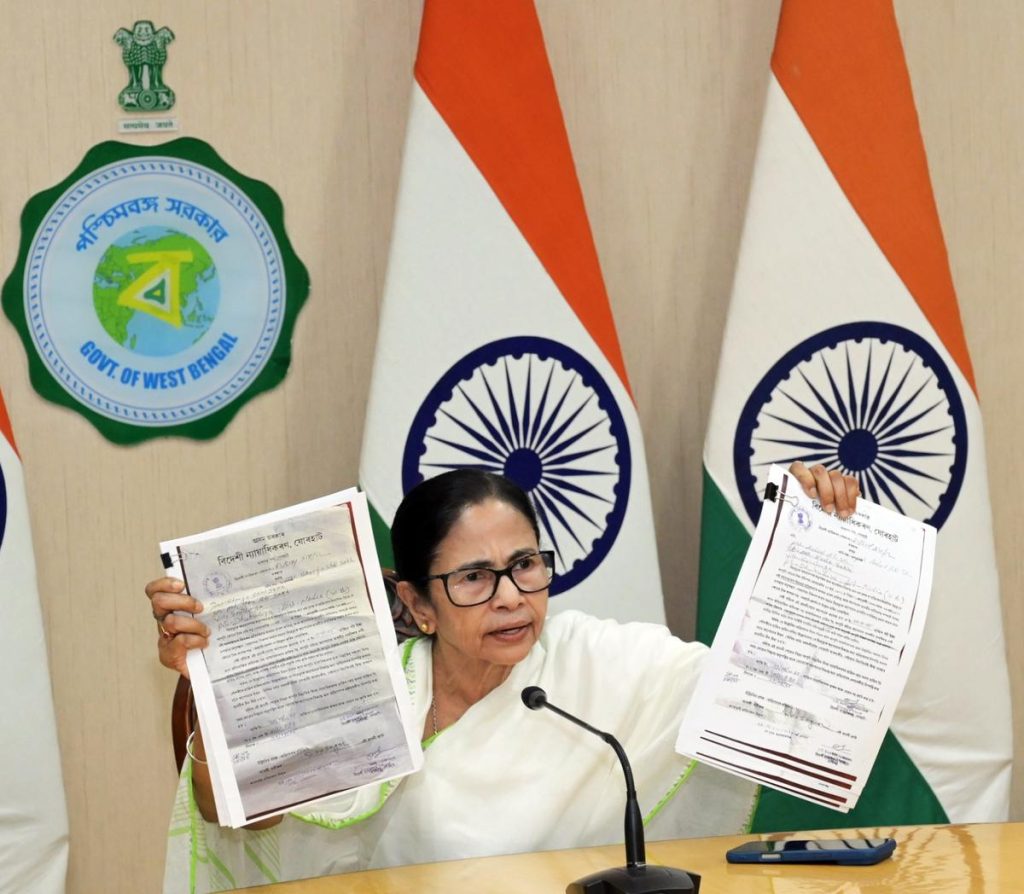
Addressing a rally in Charakdanga, Nadia district, she accused the BJP of targeting Matuas, Rajbanshi, and minority communities specifically — describing the deletions as a calculated attempt to disenfranchise entire groups ahead of the polls. M9.news
The Trinamool Congress has vowed to take every affected voter’s case to tribunals and the Supreme Court. Banerjee said Bengal would “not allow its democracy to be stolen in broad daylight.”
BJP’s Counter — “79 Lakh Fake Voters Exposed”
The BJP read the same numbers and reached an entirely opposite conclusion.
Leader of Opposition Suvendu Adhikari described the SIR exercise as overdue justice — a long-needed cleanup of a voter list he claimed had been deliberately inflated by the TMC to protect illegal Bangladeshi migrants.
Adhikari claimed that 90% of the deleted names had historically voted for the Trinamool Congress, and projected that the BJP would win over 177 seats in the upcoming elections — up from 77 in 2021 — partly because of the revision. M9.news
He used a colourful metaphor to describe the phased deletions. Breakfast saw 58 lakh names removed. Lunch brought 7 lakh more. Evening tea cleared another 14 lakh. Dinner, he said, had not yet been served.
The Bangladesh Connection — Decades of Undocumented Migration
To understand why the SIR created such specific political heat in border districts, you must understand a migration history that stretches back 75 years.
West Bengal shares a 2,216-kilometre border with Bangladesh — more than 54% of the entire Indo-Bangladesh border. The two regions share language, ethnicity, and culture. That proximity has driven decades of population movement.
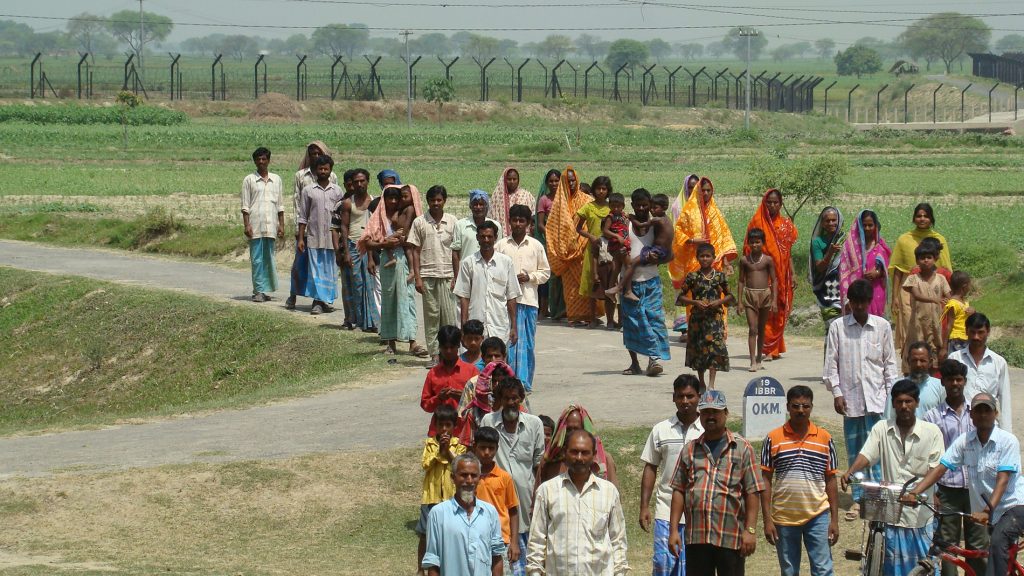
Migration from the region began with the 1947 partition of Bengal. It accelerated during the 1971 Bangladesh Liberation War, when Pakistani military action drove millions of Hindu refugees across the border. The government of India issued citizenship for those who arrived before March 25, 1971. After that date, migration did not stop — it continued, quietly and steadily, for decades. CBS News
Research conducted at the Indian Statistical Institute, Kolkata, identified the main push factors as political instability, communal violence targeting Hindu minorities, economic desperation, and the pull of linguistic and cultural familiarity in West Bengal. Over time, economic migration joined religious flight as a driver — drawing both Hindu and Muslim Bangladeshis across the border.
The scale of this movement left its mark on West Bengal’s demographics. Census data from border districts shows Muslim population growth consistently outpacing Hindu growth across every decade from 1981 to 2011 — a pattern researchers have attributed partly to continued undocumented migration.
Political parties in West Bengal, according to multiple researchers and analysts, extended protection to undocumented migrants in exchange for votes — a charge that has been levelled at successive governments across party lines.
The Real People Caught in the Middle
While politicians argue about numbers, real voters are standing in queues outside district magistrate offices, clutching documents, hoping someone will listen.
Bagbul Mallik, a small business owner from Deganga village in North 24 Parganas, submitted his documents on time. His family remains on the voter roll. He does not.
“Many voters in my village have also been removed from the list,” he said. “We are expecting that this time we won’t be able to cast our votes.”
For every name on a spreadsheet, there is a person like Nadia Mondal or Bagbul Mallik — people who have lived in West Bengal for decades, built lives, raised children, and who now face a bureaucratic wall between themselves and their most basic democratic right.
Professor Zaad Mahmood of Presidency University’s political science department described the situation bluntly: “What is happening today with 27 lakh voters whose logical discrepancies are not settled is daylight travesty of democracy. This is unprecedented.” Asharq Al-Awsat
West Bengal Voter Deletion 2026: Supreme Court View
The West Bengal voter deletion 2026 case has also reached the Supreme Court.. The Supreme Court has been watching this process closely.
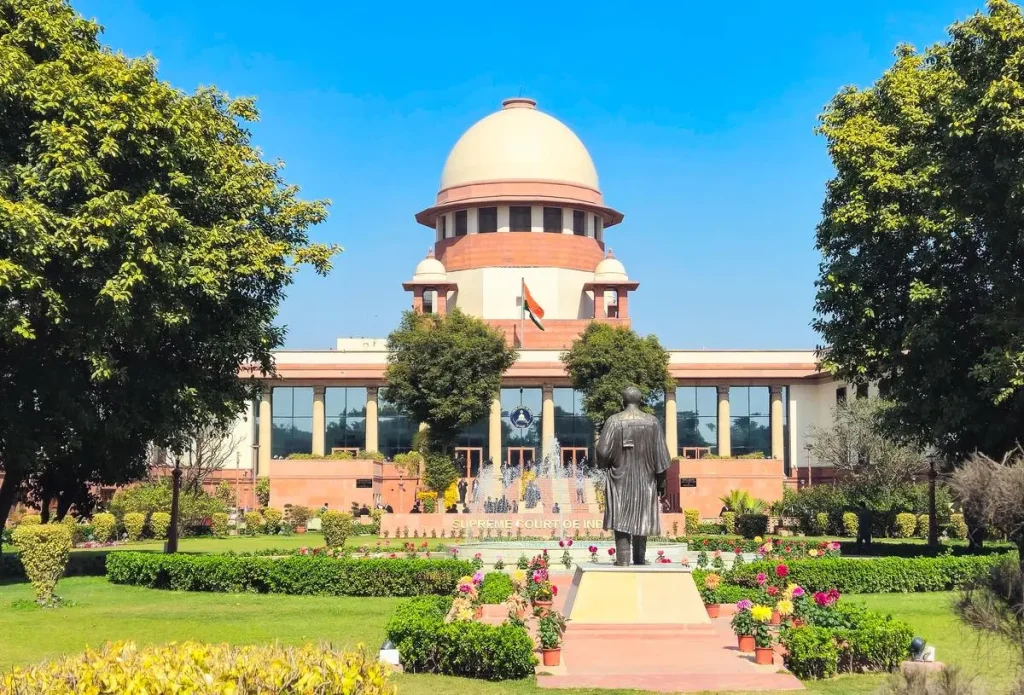
The apex court directed the formation of appellate tribunals for deleted voters to challenge their removal, but ruled out interim restoration of names — making it clear that voters who failed verification cannot be re-added provisionally. Wikipedia
Deleted voters can approach the tribunals, but the chief electoral officer confirmed that anyone whose appeal is still pending will not be able to vote in the 2026 elections. They may be included in future electoral rolls if cleared. Nation Thailand
For voters whose names remain off the list when the rolls freeze at midnight before each phase, there is no further avenue. The election will happen without them.
What the Numbers Tell Us — and What They Don’t
The Election Commission maintains the SIR was a transparent, judicial process. About 55% of the cases reviewed for adjudication were retained. Only those with genuine discrepancies were removed.
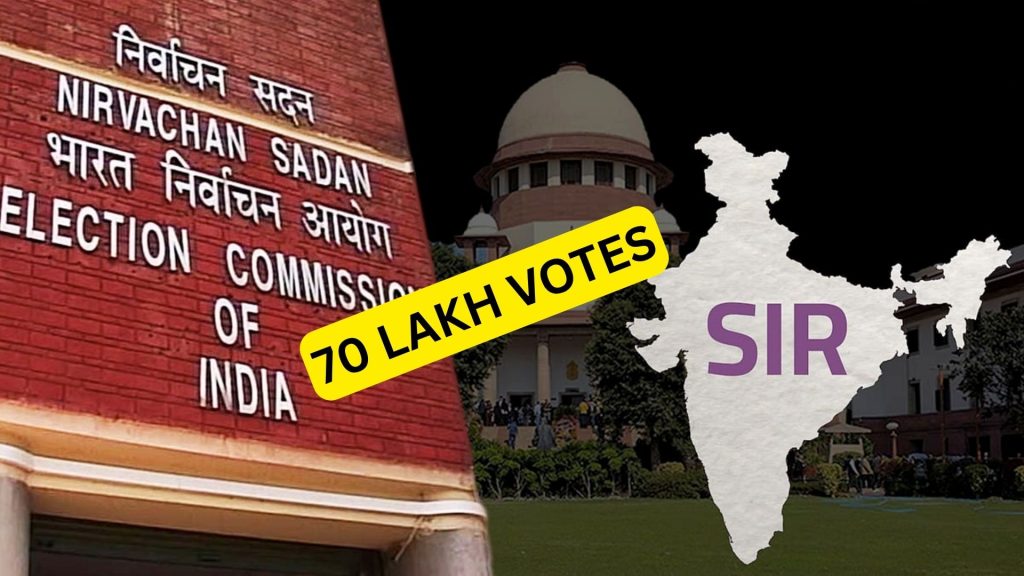
In over 140 constituencies, the number of deleted voters exceeds the winning margin from the 2021 elections — meaning the SIR has mathematically altered the competitive landscape of more than a third of all seats. CBS News
But the numbers also carry uncertainty. No official breakdown exists of how many deleted voters were genuine Indian citizens, how many were deceased or relocated, and how many were undocumented migrants. All three categories are folded into the same 91 lakh figure.
That ambiguity is the engine of the entire controversy. Every political actor interprets the same number to confirm what they already believed.
Two Phases, One State, Infinite Questions
West Bengal votes in two phases — April 23 across 152 seats, and April 29 across the remaining constituencies. Counting is scheduled for May 4.
The TMC-BJP clash over the SIR has already produced violence. Seven judicial officers were held hostage in Malda district for 9 hours during the adjudication process — an incident the Supreme Court criticised the Bengal government for failing to prevent. M9.news
What is clear is that West Bengal’s 2026 voter deletion controversy will shape this election long after the ballots are counted. The 91 lakh deleted names are not just a statistic. They are a map of where power is contested, where migration has reshaped demographics, and where the line between cleaning a voter list and disenfranchising citizens is being drawn and redrawn in real time.
The Question Every Voter Is Asking
A democracy’s most basic promise is that citizens choose their government. Overall, West Bengal voter deletion 2026 raises serious questions about electoral fairness.
When 91 lakh people arrive at the question of whether they can cast a vote — and find the answer depends on their district, their community, their paperwork, and the speed of a tribunal — that promise starts to feel conditional.
Is an election free and fair when millions of its voters are still fighting to be on the list?
Quick Reference — West Bengal Voter Deletion 2026
| Detail | Figure |
|---|---|
| Total voters deleted | ~90.83 lakh (91 lakh) |
| Original electorate | 7.66 crore |
| Post-SIR electorate | ~7.04 crore |
| % of electorate deleted | ~11.8% |
| Deleted in Feb 28 final list | 63.66 lakh |
| Deleted after adjudication | 27.16 lakh |
| Cases reviewed for adjudication | ~60 lakh |
| Highest deletion district | Murshidabad — 4.55 lakh |
| 2nd highest | North 24 Parganas — 3.25 lakh |
| 3rd highest | Malda — 2.39 lakh |
| Election Phase 1 | April 23 — 152 seats |
| Election Phase 2 | April 29 |
| Results | May 4, 2026 |
FAQ — People Also Ask
Q1. What is the SIR in West Bengal elections 2026? The Special Intensive Revision (SIR) is an Election Commission of India exercise to clean up electoral rolls by removing deceased voters, duplicates, and people who have permanently relocated. In West Bengal, it resulted in the deletion of around 91 lakh names — nearly 12% of the state’s total electorate — ahead of the 2026 assembly elections.
Q2. Why are so many voters being deleted from West Bengal’s voter list? The ECI says the deletions were based on judicial scrutiny and document verification. Critics, including Chief Minister Mamata Banerjee, allege the deletions disproportionately target minority and marginalised communities in border districts. The BJP argues the deletions expose fake voters linked to illegal Bangladeshi migrants.
Q3. Can deleted voters vote in the 2026 West Bengal elections? No. The Supreme Court ruled that voters whose names were removed after adjudication cannot be provisionally restored. They can appeal before appellate tribunals, but if their cases remain pending when the electoral roll freezes before each phase, they will not be able to vote in 2026. They may be re-enrolled for future elections if cleared.
Q4. Which districts saw the most voter deletions in West Bengal? Murshidabad recorded the highest deletions at 4.55 lakh, followed by North 24 Parganas at 3.25 lakh and Malda at 2.39 lakh. These are all border districts with significant minority populations and historical connections to migration from Bangladesh.
Q5. What is the connection between Bangladeshi migration and West Bengal’s voter list? Research conducted over decades shows undocumented migration from Bangladesh has significantly altered the demographics of West Bengal’s border districts. Political analysts on both sides allege that some undocumented migrants were enrolled as voters over the years, with parties of different persuasions accused of facilitating this for electoral advantage. The SIR was partly aimed at identifying such entries.
Sources & External Links
| # | Source | Link |
|---|---|---|
| 1 | Free Press Journal — 90 Lakh Voters Deleted | freepressjournal.in |
| 2 | India TV News — 90 Lakh Names Removed | indiatvnews.com |
| 3 | Oneindia — 90 Lakh Voters Removed | oneindia.com |
| 4 | Kashmir Media Service — Disenfranchisement Concerns | kmsnews.org |
| 5 | The Federal — TMC EC Clash | thefederal.com |
| 6 | The Week — Voters in the Dark | theweek.in |
| 7 | The Researchers — 27 Lakh Barred | theresearchers.us |
| 8 | The Quint — 11.67% Voters Deleted | thequint.com |
| 9 | National Herald — Bengal Voter List Row | nationalheraldindia.com |
| 10 | The Researchers — 91 Lakh Voters Deleted | theresearchers.us |
Also read : https://behindevidence.com/india-nuclear-reactor-news-breeder-reactor-project/
Give an eye on : https://behindevidence.com/trump-news-today-fact-check-hospital-rumour/